
When I think about The Listening, a lot of warm feelings start bubbling up inside me.
Lights is an artist that I’ve been a huge fan of for pretty much my entire life as a music addict, and there are very few artists that I can confidently say I loved as a teenager and still love just as strongly as an adult. She’s firmly among my favorite artists of all time, right up there with Pearl Jam and Lupe Fiasco. I first found her music in high school, and from there she became one of the few artists where I’d eagerly anticipate the next release, even staying up late on release dates and discussing with other fans on the forums, well before Reddit and fan Twitter took off.
The Listening? I’ve heard this album a thousand times. In its entirety and in playlists. On streaming, on Youtube, downloaded, on CD, on vinyl, in concert. Studio versions, acoustic versions, live versions, remixes. While driving, while sitting in my room, while on the bus to school, while on the plane moving across the country for my first full-time job. I’ve heard it at 14, at 17, at 21, and now, at 27. It holds such a special place in my heart because of all of these memories and emotions tied up with it.
But never before now did I listen to this album with the intent of writing about it, with this goal of capturing how it moves me and why.
This year, I’ve been reigniting my love for music after some years of depression and turmoil, and a big part of that was revisiting Lights’ music, which I hadn’t actively followed since Midnight Machines back in 2016. And in coming back to her music, I found I still loved it just as much. I explained this deeper in my Siberia review, but one of the reasons I started writing reviews is to finally get the chance to praise artists who I feel deserve more fanfare, and more writing exploring and appreciating their work. And yes, I set up this blog and worked on my writing skills specifically so I could eventually honor Siberia with a proper, loving review.
So then when the time has come to write about Lights’ debut album, an album that has stuck with me for almost 15 years now, how do I even start? Do I start by describing the album and what I like about it musically? Do I focus instead on how I came across it and why it stayed with me? Do I detail all the things this album did that still make it unique today? Revisiting this album for the last months, listening to the project many times closely, with these waves of nostalgia washing over me, racking my brain trying to figure out what to say about this album when I have so much to say about it, I finally figured out what I wanted to focus on if I were to write about The Listening.
What I want to talk about is how this album has changed for me over the decade and a half since it first released.
I think more than any other, this is an album that has grown with me. I don’t mean its grown on me, but with me.
I don’t mean to just say “as I listened to it more, I liked it more”. No, that’s happened with a lot of albums. What I mean is, the meanings I take from this album now are entirely different from what I saw in it when I was young. It has evolved with me, its messages shining with new meaning as I have grown and matured as a person.
The Listening is an album that is very much concerned with the passage of time, taking a pining look to the past, and how things have changed since the simplicity of childhood. I’ve decided I want to write this retrospective in a way that would follow the spirit of this album, and reflect on what it means to be nostalgic, what it means to reminisce, and most importantly, what it means to grow up.
So in this look back on The Listening, I’m going to describe what this album meant to me when I first found it as a teenager; then, I’ll try to explain what it means to me now, how it has grown and changed alongside me thematically and emotionally; and from there we will wrap around to my actual review of the album, trying to consolidate what all the different Me’s listening to this album over the years saw within it.
Alright. Let’s unpack this special album.
The Listening, back then
I found this album when I was about 14, and immediately it filled a void for me personally. It emanated a warm, sincere energy to balance the cynicism and angst that I so stereotypically carried as a teenager. Being old enough to start to see the stresses of the world, but not yet old enough to really do something about it, it’s no surprise most teenagers are sarcastic and edgy, and I was no exception. My music taste pretty much matched that: grunge, metal, and 90s hip hop were my soul at the time. Which was why The Listening stood as such a balancing force for me. I felt it had this optimistic innocence to it, almost encroaching on naïveté. The production was bubbly and whimsical, the sentiments were kind and encouraging.
I feel I took a lot of comfort in this album, because at an age where I felt like I was growing up too fast, this album felt like childhood. The girl singing into the mic seemed like she could be any one of us. The songs didn’t have the dry irony or detachedness of much of the art of the time, and her voice and writing felt yearning and wishful. The album came across diary-like, with the lyrics often venting wholeheartedly about emotions, stress, love, and faith, without pretense or purple prose. It was this lack of pretense, eschewing complication, that made the album feel so genuine, so heartfelt.
From a songwriting perspective, there was something so soothing about songs like “February Air” and “Quiet”, which float on by like warm lullabies. The soundscape was twinkling and cozy, the vocals gentle and breathy.
And as any Lights fans from that Myspace era know, her vlog era was such an experience, where she would have her acoustic guitar, singing songs from the EP and this album, chatting with fans — it was hard to watch any of those and not be left with a smile. It just felt so pure, so joyous. A really close-knit community too! It was just really fun being a Lights fan.
Altogether, teenage me found an escape from the world and situation around me within this album. It was a dose of simplicity and sincerity, a form of auditory eye-bleach, to palliate the increasing cynicism that was characteristic of me then.
Which is all the more interesting to me now, because of how this album makes me feel when I listen to it all grown up, how it has changed alongside me to come to represent new meanings. If you had asked me as a teenager what this album is about, I don’t think I’d have had a good answer, as I didn’t meditate on it as deeply as I have done recently. In a way, I’d even say the appeal of The Listening to me was precisely because I didn’t meditate on it, and could enjoy it without thinking too much. I believe, at the time, I lacked the life experience to properly understand what this album is about.
The Listening in 2025
So, after being a die-hard Lights fan up until about 2016, I kinda just fell out with music. Whether it was depression, major life events and career, or just coincidence, I wasn’t listening to nearly as much music, and that lasted for a long while. During these few years, I pretty much just listened to the rap music that was comfortable to me, mostly Curren$y and Griselda.
Then, towards the end of 2024, I finally returned, going back to my favorite artists, and of course, central in that process was revisiting Lights after over a half decade. I put my headphones in, hit play on The Listening, and closed my eyes.
I don’t think I’ve felt such a deluge of emotions and feelings swell up so rapidly. With how closely I used to follow her music, her vlogs, catching her on tour, and then just not doing that for 8 years, it felt like hearing from an old friend again.
Remembering all the times I’d listen to her albums on the school bus, in study hall. Desperately trying to find Siberia on vinyl as a 16 year old who just got his first shitty all-in-one record player. Following the Little Machines roll-out avidly with other regulars on the IAmLights message board.
And with that, it felt like finding a part of myself again, unlocking all these warm memories, remembering old versions of myself that had been long forgotten and lain dormant. It felt like coming home, reconnecting with my old self by reconnecting with the music my old self cherished.
And with this look back in time, I think I can now say I have a truer understanding of the album. The Listening really is an album reflecting on the passage of time. While as a teenager, I felt like the album’s sound carried a child-like exuberance to it that helped take me back to the simplicity of childhood, I think now as an adult, it feels profoundly wistful, that aforementioned exuberance coming across more like an intentional exercise, an active choice, rather than an artist simply expressing herself in the moment.
You see, a thing that stuck out to me even as a teenager was that Lights was 22 when she made this album. As silly as it sounds now, to 14 year old me, 22 definitely seemed “fully grown-up”. It stood to reason that as we got older, our perspectives would only be more jaded and pragmatic, so it was always a little perplexing to me how youthfully sincere this album was.
Being now on the other side of 22, I think I get what this album was. It now reads to me as a young adult being brought to reckon with the shifting tides of adulthood and the existential complexity it brings with it, then contending with all of that by channeling these emotions and anxieties into an album — an album that itself depicts a desire to escape these ambiguities of growing up, and yearns nostalgically for the time when it was all so much simpler. That honest vulnerability now feels less like the result of innocence or naïveté and more so this process of laying out emotions visibly so that we may work through them. In doing so, the album seems to go even further, reaching towards a resolution of these anxieties, in a development of personal growth and self-confidence.
Let’s step through the album now, and I’ll explain how, as someone who struggled a lot in my early 20s with growing into a well-adjusted independent adult, this album speaks directly to this phase in our lives, and how we might try to find our way through it.
Can I Let The Ground Do The Walking?
Starting with “Saviour”, this song is a bit of a calling card for Lights, I think. The lead synth melody is iconic and unmistakeable, and within moments she’s off to the races, with no real wind-up or introduction vocally. It’s written and delivered almost like it’s an uncontrolled outpouring of confused emotions. The words are sung rapidly during the verses, and Lights is running through a laundry list of struggles she is having to confront.
The night is deafening
When the silence is listening
And I'm down on my knees,
And I know that something is missing.
Because the
Back of my mind is holding things I'm relying in
But I choose to ignore it
Because I'm always denying them

I'm a bit of a manic
When it's not as I plan it
'Cause I start losing my head
And then I get up in a panic
Remember when we were kids
And always knew when to quit it
Are we denying a crisis
Or are we scared of admitting it?
I don't want to know
I really love how distinct this song sounds. Most pop songs tend to have some kind of soft beginning, easing into the song slowly in terms of vocals, but this one jumps immediately into a pretty dense verse, just line after line without much of a pause. Not just dense in delivery, but content: there’s heavy pensiveness in the lyrics here, dwelling on these sentiments of feeling incomplete and being unable to control the situation around her.
I think putting this song right at the front is meaningful in how it emphasizes the heady, pondering aspect of this album. The indeterminate nature of the lyrics is important to me as well — it’s clear she’s saying a lot and feeling a lot here, but it’s unspecific and vague, implying to me that it’s a complex and ambiguous problem she’s dealing with.
Note the bolded line: it’s the first of many instances on this album that wil describe wanting to go back, to when it was simpler, and all these confusions and ambiguities of adult life were not there. It’s an early inkling of what I think develops into a central theme of this album later on.
The freneticism of the delivery only comes to a break when the hook comes in, which wishes for a respite from the ambiguity, into something safe and sure. Amidst a sea of troubles, there’s this desire for something as straight as an arrow, an objective guidance.
I just want to run to you
And break off the chains,
And throw them away
I just want to be so much
And shake off the dust that turned me to rust
Sooner than later,
I'll need a saviour,
I'll need a saviour
I think it’s fitting how the delivery of the hook slows the pace of the song down; it indicates to me how seeking solace in faith or a savior might allow a person to slow down a little, and make sense of the delirium we might feel when it feels like life is coming at us at a hundred miles an hour. It feels like a reduction of the many, many things bothering us into a singular focus on something that might save us. As someone who was an atheist as a teenager and has recently incorporated more Hindu philosophies into my life, setting my focus on a single thing like breathing or a specific thought has been a great way to center myself when I’m overwhelmed, so I can definitely see a similar thing going on here in this song. It’s for these reasons that I tend to think of “Saviour” as an ode to the over-thinkers.
I think thematically it makes sense to pair an analysis of “Saviour” with the following song, “Drive My Soul”.
Seems somebody burned out the signs
I can't expect the hard curves
There's no borders, there are no lines
How can I know where to turn?

You make the streetlights reappear
I feel bright when you stand near
I know what I am when you are here
My place becomes so clear

When you're gone
Will I lose control?
You're the only road I know
You show me where to go
Who will drive my soul?
Where “Saviour” speaks on the ambiguities of adult life in a fittingly abstract and non-specific manner, “Drive My Soul” touches on the same topics with lyrics that are more visual and direct — here we have imagery of streets without signs as an analogy for the wayward, unguided aspect of having our entire future within our own control, and being daunted by the prospect.
As Kierkegaard said, “anxiety is the dizziness of freedom” — our freedom to choose among a million paths is really what causes us to feel so overwhelmed at this point in our lives. Personally, it was in that period from age 20 to 24 where I was most interested in philosophy, especially existentialism and Hindu philosophy, desperately seeking a way to convince myself of objective meaning and purpose in life, anything to reduce the overwhelming infinitudes into a manageable and focused path forward.
I see this struggle in “Drive My Soul”; I think when faced with this enormous difficulty in deciding which road we want to take in life, it’s very understandable to seek some divinity or grand intelligence to take the wheel on our behalf and drive us forward. As said in “Saviour”, I don’t want to know, just take control and steer me in the right direction. It can be a source of great comfort to feel like there’s someone or something watching over us, guiding us. In fact, Kierkegaard himself did believe a leap of faith to be the way out of our anxiety, so altogether I enjoy how “Drive My Soul” puts these ideas to music in such a compelling way.
I really love how this ruminating, despondent concept in the writing is paired with the instrumentation here. The pulsing synths and moody, atmospheric pads give the song a distinctly nocturnal, shimmering vibe, that when placed underneath the seriousness of the lyrics just makes this song sound so unique to me. It’s somehow exuberant and somber at the same time. The belting during the latter half of the song puts her vocal abilities clearly on display, but more importantly, I feel they show that these feelings of waywardness are not solely dismal but also powerful, in the way they can bubble up over time and cause a person to release all that energy in a burst. Overall, this has always been one of my favorite songs on the album, it’s so singable and yet the lyrics are so contemplative. I’ll speak more to this soon, but this is undoubtedly one of Lights’ most strengths as a songwriter: this ability to balance musicality and contemplation so seamlessly.
As an aside, a musical moment I really love in this song is around the 1:55 mark, in the way she enunciates the first portion of the hook just that little bit more — “who will drive my sooooulll?” — right before belting those words the next time she sings them. It’s a bit of ear candy for me, the emphasis increasing gradually, almost as if those belted vocals are trying to push their way through to the surface.
Another part of growing up is that there’s this inherent struggle with change. I think in our early 20s, everyone we know is starting to go off on their own paths. Friends we loved slowly grow apart from us, our parents visibly age before us and become less involved in our daily lives, and places we knew and grew fond of no longer maintain the same presence and relevance. Personally, the way that everything was always changing made me feel like there was nothing I could hold onto without it inevitably slipping out from my grasp, like sand sifting through my fingers. I think the third track, “River”, speaks to this same world-weariness, seeking something permanent amidst the flux and flow of life.
Out across cities I see buildings burn into piles
And watch the world in wonder as mountains turn into tiles
And trees losing their leaves, and our faces becoming tired
I wish I could discover something that doesn't expire
Come and stumble me

Take me river, carry me far
Lead me river, like a mother
Take me over, to some other unknown
Put me in the undertow
...
Such are the things that make a kingdom rumble and shatter
The same dynamic that another day would never matter
It really just depends on who's giving and who's receiving
And things that don't make sense are always a little deceiving
Come, and stumble me
...
I want to go where you're going
A follower, following
Changing, but never changed
Claiming, but never claimed
Just like the first two songs, we see the familiar structure of laying out a list of troubles that appear in this process of venturing out into the world on our own two feet for the first time, and having these confrontations erode at our sense of being. Then, there’s this longing for something to help make the problem easier to deal with — in this case, a river.
Where “Drive My Soul” was focusing on trying to illuminate the right path forward when everything is dark and blurry, “River” seems particularly concerned with things falling apart, watching this ongoing decay in dismay. I think seeing things decaying around me always disheartens me because my immediate next thought is how I’m not exempt from that process, I too will be among those decaying things in time. It’s a frightening thought for sure, and it definitely would be great if there was a river that could carry me away from that reality. I think it’s no coincidence that many mythologies across the world have associated a river with passing into the afterlife, whether its the Ganges River in Varanasi in India, or the River Styx to the ancient Greeks. The way water continuously flows, unimpeded, serves as a very visual parallel for how time flows without concern for whether we want it to slow down, carrying us all forward every second.
The bridge is potent for this reason, centering this desire for this river that is “changing but never changed, claiming but never claimed”. I originally thought this part was saying, “I’m fine with changing, but only when it’s my choice, and not from an external cause I can’t control”? I’m still not sure. It’s unclear to me whether “changing” refers to the river itself changing, or the river changing something else. I think the parallel structure with “claiming” leads me to believe the latter, that this river that is changing the land around it, claiming the banks and growing deeper and wider through erosion, while the river itself is immune to being changed or claimed by others. From there, I think my reading of this line is now “I want to make changes to the world, and make an impact, but I don’t want it to change me or claim a part of me in the process”.
I notice also that the river is compared to a mother — I think this is a significant choice of wording, evoking again that desire to be like a child, guided by the hand, taken in the undertow.
One line that always stuck out to me is “things that don’t make sense are always a little deceiving”; I feel this is one of those aphorisms we often find in Lights’ writing. These are lines that add to the theme of the song but they also stand out from the song in a way that keeps them bouncing around in my mind even when I’m not listening. I think just three songs into this debut album, we can already see her writing as something different from what is common in pop music — her style has always been more poetic, each line feels imbued with this noticeable tinge of pondering. I think where other pop music pulls off the task of getting you to think less and enjoy the moment, Lights’ writing often contains a bit more to mull over and meditate on. I think this kind of writing is found throughout her discography, most notably to me on “Everybody Breaks A Glass” from Siberia, and this juxtaposition of pop energy and meditative writing has always made her music a unique experience for me.
Speaking of Siberia, I didn’t end that other paragraph with “the flux and flow of life” as just a slip of phrasing — I do feel now that “Flux and Flow” from Siberia reads to me as a re-examination of this same idea of wrestling with impermanence and change, with Lights instead embracing the ever-changing nature of life, even taking solace in it, viewing that constancy of change as an opportunity to retry, to “take another turn with a better hand”, rather than it being something to lament.
While the previous songs take a notably Christian theming in their battle with existential confusion, “River” appeals more to nature. I would characterize it as still being religious, or at least spiritual, in the way this river is depicted as a purifying, guiding force of nature, much as an animistic or Transcendentalist framework might illustrate divinity. As an Indian, I am definitely reminded of the religious imagery of the Ganges River purifying people’s souls in Varanasi. We also see this language of “a follower following”. I think Lights has been somewhat open about the role religion has played throughout her life, from being Christian around the time of this album, to more irreligious later on.
I only bring this up to say that I won’t really be trying to connect things to her personal life in this review. I prefer to stay away from inspecting an artists’ personal life when discussing their music. Art obviously is a reflection of the artist’s experiences and trauma, and it is tempting to try to understand the “lore” behind the songs we love. But as well-intentioned as it could be, I think AT BEST, such analyses are speculative, and at worst, they’re intrusive and disrespectful of an artist’s privacy and personhood. So I will focus here and in future reviews solely on what the song itself seems to be indicating, and won’t use anything from an artist’s personal life to corroborate an analysis unless the artist themselves has shared that context publicly when discussing the work. I believe the religious undertones here to be significant insofar as it portrays one effective way a person might contend with the struggles of growing up and facing existential ambiguity, but I don’t think prying further into this particular artist’s relationship with religion is needed to appreciate this album.
Moving on, I think the title track on this album is as all title tracks should be; it captures all the musical and lyrical themes of the project in one place, a microcosm of the album as a whole. We hear the sonic palette of this album — glimmering synths, moody pads, and sweetly-sung vocal melodies. We also hear the introspection and honesty of The Listening, with Lights stating plainly the emotions she’s dealing with. Similar to “Saviour”, I feel this song feels like a mild panic attack lyrically, a stream-of-consciousness approach to depicting the situation of being overwhelmed with emotions and unable to focus and communicate.
Please excuse me, I'm not thinking clear
It must just be stress but I likely shouldn't be here,
I'm such a mess

I never really ever know what to say
When all of my emotions get in the way
I'm just trying to get us on the same page
I always get it better right afterward
When all the wrong impressions are said and heard
How come I can never get the right words, I need to convey
Wish I could explain

The things that I have to work out
I don't feel right
What has come over me, I'm about
To lose my mind
I really do want to praise this song’s writing. I feel the best writers are able to directly channel an emotion into a song, without any filtering or intellectualization of it — to capture the raw feeling and convey it as it is, avoiding any processing that might strip it of that immediacy. I’m reminded of impressionist art, which intends to capture the feeling of seeing something beautiful rather than attempting to photo-realistically depict that sight. This is a place where my opinion of this album’s writing has changed over the years — I used to think it a bit simplistic, but now I view it as emotionally transparent. Instead of poetically adorning the emotion being felt, this style of writing communicates the emotion by putting us directly in the head of the person, letting us feel it in first-person. It makes the writing feel so much more alive and felt, rather than meticulous and clinical. It’s very hard to convey things exactly as you feel them.
This is all a bit ironic haha — I’m praising how effectively she communicates a feeling, on a song that’s explicitly about having difficulty expressing herself clearly.
I especially find the bridge to be really evocative, and it’s actually one of the lyrics that immediately comes to mind when I think of this album:
Can I let the trees do the talking?
Can I let the ground do the walking?
Can I let the sky fill what's missing in?
Can I let my mouth do the listening?
I feel this continues that thematic trend from the earlier songs! This song again has her detailing an emotional problem she is facing, and then wishing there was a way to defer the difficulty of dealing with that subjectivity. This time not to God or a river, but to the trees, the ground, and the sky. Of course, it’s less solution-seeking, and more of a vent, but that theme is still tangible to me whenever I hear this song. There’s just something so poignant and imaginative in the way this bridge is written that I still can’t quite put words to. So I’ll just say, I find this to be quite a cleverly-written way of saying, “Hey, dealing with this emotional stuff is really hard — can I somehow get an easier way to handle it?”
I also think the song is really beautifully sung, the vocals get the emotion of the song across perfectly. A moment I especially love is at the end of this bridge, where her singing voice starts to fade into what is almost a cry/whimper, really gluing the helplessness felt in the writing with the musicality of the vocal delivery. Overall, the frustration of not being able to communicate in a perfect, clear way is just conveyed so perfectly by the way she sings here.
Let’s Play Pretend
I think when we view this first chunk of the album together, we see a young adult beset with all sorts of existential dilemmas, trying to catch a break from the ambiguity through all the ways they can think of, whether its praying for a savior, fantasizing about floating away on a river, or venting it all into music.
I don’t mean any of this as a critique, I think it’s truly brilliant how eloquently this album puts to music what I was going through around this age. I would be seeking every and any method to reduce the subjectivity and undirected-ness of newfound adulthood into something objective and steadfast. Choosing my own path in life felt like a monumental task, and I was often paralyzed when it came to making such big decisions, wishing there was a way to make that decision easier or have someone else make it for me. It’s something we all go through and we each try to find our own ways to adjust to adulthood. I really appreciate having an album that feels like it captures this battle we all fight.
And one really important way we react to growing up is nostalgia.
We have seen sprinklings of a yearning for the past so far, but I think in “Pretend”, that becomes the focus.
This song, to me, is the conceptual anchor of the entire album. It’s the song that puts every other song into its appropriate context. It was when this song came on during my re-listen that the entire album snapped into place for me. Without this song, I don’t think I’d have reached the interpretations I’ve shared here for the previous songs; each line on “Savior”, “Drive My Soul”, “River”, and “The Listening” seems to glow so brightly with intention and conceptual coherence in the light of “Pretend”. Despite the album appearing whimsical and innocent to me as a teenager, it’s in re-listening to “Pretend” that I found all of those affirmations and optimisms to be tinged with wistfulness, with longing, with bittersweetness.
Because of how important this song is to interpreting this album, I’m going to share the lyrics for the entire song:
Once in a while
I act like a child
To feel like a kid again

It gets like a prison
In the body I'm living in

Because everyone's watching
Quick to start talking
I'm losing my innocence
Wish I were a little girl
Without the weight of the world

It would be nice to start over again
Before we were men
I'd give, I'd bend
Let's play pretend

Remember the time
We had soda for wine
And got by on gratitude?
The worst they could do to you
Was check your attitude
Yeah, when fights were for fun
We had water in guns
And a place we could call our own
How we lost hold of home
I guess I'll never know

It would be nice to start over again
Before we were men
I'd give, I'd bend
Let's play pretend
And when it's the end
Our lives will make sense
We'll love, we'll bend
Let's play pretend

It's not going to be long
Before we're all gone
With nothing to show for them
Stop taking lives, come on
Let's all grow up again

It would be nice
To start over again
Before we were men
I'd give, I'd bend
Let's play pretend
This song is such a gut-punch to me whenever I’m listening to this album now. It feels like a sorrowful look back on the past, to a simpler time, wishing for a time machine to go back to it, leaving all of this existential grayness behind. It’s powerful, it’s alluring, it’s mournful. And it again affirms the themes of the album so far: trying to find ways to escape the problems we face as adults. I did this a lot, with my early 20s involving a phase where I’d go back and rewatch the cartoons I’d watch as a kid, or revisit places I’d often be playing as a kid, wishing desperately to have that magic and whimsy back in my life. So I definitely relate to Lights in this song.
You know which line especially gets me emotional? “How we lost hold of home, I guess I’ll never know”. It speaks to what I think is almost a form of guilt I felt for not appreciating the innocence and joy of childhood while I had it. But that’s impossible isn’t it? To understand what made that time special and innocent, you have to live without that innocence first — you have to become an adult to understand what it meant to be a child. She alludes to this directly:
Because everyone's watching
Quick to start talking
I'm losing my innocence
Wish I were a little girl
Without the weight of the world
It’s this process of losing innocence and trying to recapture it that I find is explored so vividly by The Listening. And it’s this same process that I feel this album was intended to manage. This is more of a speculative head-canon on my own part, but I like to think maybe the album sounds the way it does, and that Lights writes and sings the way she does on this album, specifically as an exercise in immersing herself and us, just one more time, in those feelings of whimsy and nostalgia. In comparison to all of her later work, The Listening stands out uniquely: its production is bubbly and dreamy; Lights’ voice is breathier and gentler; and the writing is simpler, more emotionally direct, and more unassuming. It is through “Pretend” that I feel my impression of the album’s spirit went from it being a genuine reflection of an innocent and optimistic person, to being the outpouring of a person longing to recapture that innocence and optimism, having lost it in the process of growing up. I see this in the very first line: “once in a while, I act like a child, to feel like a kid again”.
Take a look at some of the music videos from this album:
What sticks out to me is the juxtaposition of these pensive, heady lyrics with this DIY, retro-futuristic aesthetic of the videos of The Listening. It comes across like a kid being given a small budget to shoot a video, and they’re putting all the stuff a kid would find cool into it. The astronaut, spaceships, the control console with the glowing buttons and knobs — it all just evokes these nostalgic memories of low-budget 80’s sci-fi movies or children’s TV like Power Rangers and Lazy Town. The contrast of these childlike elements with the solemness of the lyrics is palpable but nuanced in how it distinctly gives the feeling of an adult looking back with nostalgic sadness at things they loved as a kid. It gives me the same feeling I had when I found a box full of my old toys I’d play with as a kid, and pulled them all out to just play with them all one more time and reminisce. I can feel this aesthetic tying in with the overall theme I just mentioned; trying to pull together the memories of childhood and immerse ourselves in them once more in an attempt to rekindle that magic.
Maybe this is why, when I was a teenager, this album sounded like childhood to me.
Looking for Wisdom in the Dark
I think this now sets the stage for the changes we see in the second half of the album. I truly feel now that the second half of the album reads as a direct response to the first half. The first half is largely characterized by a person feeling distraught by the pains and sorrows of growing up, besieged on all sides by problems and ambiguities, seeking some form of escape from it all. The second half flips that, demonstrating this great character development that resembles a Hero’s Journey of overcoming one’s struggles and becoming stronger through them.
It begins with “The Last Thing On Your Mind”, which is the first of Lights’ “uplifting” songs on this project. As a teenager, I used to read these songs as straight-forward empowering songs meant to encourage younger listeners to fight through their struggles, almost feeling a little saccharine to me as a result. I now view this differently. Let’s look at the lyrics of the hook, leading into the second verse:
Sing, the last thing on your mind
The last word on your breath
I'll be the one to keep you
I'll keep you at your best
The last thing on your mind
'Cause I don't need your mess
I'll be the one to keep you
One disaster less

Straighten up your tie
Take the microphone
Forget about it
Don't let it get you down
It’s actually a line from a later Lights album, PEP, which I feel changed my perspective on this song: “Nothing like a pep talk to yourself, it works every time”. From the line about taking the microphone, I get the feeling she’s talking to herself in this song, because it seems to be motivating a performer to take the stage. Or, it could just be reaching to anyone else who’s in a similar position.
I also notice an interesting parallel between this song and the title track. “The Listening” had her venting everything she feels insecure about and exclaiming “I’m such a mess“, and here it reads like she’s singing back to that version of her, saying “I don’t need your mess, now get back on stage and sing :)”. It could just be a phrasing she likes using, but to me it comes across like a callback. I think where the first half was more passive, showcasing someone who is singing about things happening to them, there’s a shift to a more active, commanding role starting with this song.
In that vein, we see another contrast to the earlier songs: “Saviour” and “Drive My Soul” have this pleading for someone to come and save her, but in this hook, she is the savior, she is the one who will be preventing disaster. I think one of the ways I was able to fight through my struggles with purpose during that period of my life was to find inherent meaning in helping others, whether through organizing for political and workplace action, or just trying to help people in everyday life. I see that idea being manifested in The Listening, that one way to resolve the ambiguity of right and wrong without objective morality is to simply live with the purpose of uplifting others. I can imagine that with this being her debut album, maybe she was able to find meaning in being an artist who can help people through her music.
“Face Up” has a similar gist, its emotional exigence being the same desire to emotionally uplift others while still reading like it’s partially directed at herself as a pep talk. The way the first verse is written in first-person perspective followed by the hook being in second-person definitely leads me to view it as this internal dialogue of sorts with herself.
I think the second verse is especially pointed when it comes to the changes we notice in growing up and witnessing the passage of time:
Seems like the more you grow, the more time you spend alone
Before you know it, you end up perfectly on your own
The city's shining bright, but you don't see the light
How come you concentrate on things that don't make you feel right

I just want to feel alive

The times you don't wanna wake up
'Cause in your sleep it's never over when you give up
The sun is always gonna rise up
You need to get up, gotta keep your head up
Look at the people all around you
The way you feel is something everybody goes through
Dark out, but you still gotta light up
You need to wake up, gotta keep your face up
The first two lines hit really close to home, especially as a man, because I feel whether due to toxic masculinity or regressive gender roles, a lot of us have trouble maintaining relationships in adulthood. This leads to a painful lingering loneliness, partly of our own creation, partly a result of culture. I appreciate hearing something like this discussed in a pop song; I think the isolation people often feel as they get older and drift from their close friends is something so common and so dismaying, yet so under-represented in mainstream music. Probably because it’s a bit of a moodkiller to think about, but hey, as a fan of metal, goth, and emo, I think the sad emotions deserve just as much love in pop music as the happy ones.
In a way, I also see those latter two lines in the second verse as responding to “Drive My Soul”. In that song, she was lamenting that it feels like the lights and signs of the city have been put out, leaving her without direction. Here, we see a return to the lyrical motif of lights and the city, except it’s being flipped; the lights are still shining, it’s just that she couldn’t see them. Being “unable” to see the lights that are already there is a common trope when it comes to depression and purposelessness, and I feel “Face Up” when read this way comes across again as a response to the first half of the album. “Dark out, but you still gotta light up” shares this overall sentiment I see in the second half, which is that you can’t really expect someone or something else to come save you, you need to pull yourself out from that abyss yourself. You will need to be your own guiding light.
I feel these ideas are expressed most emphatically in the next song, “Lions”.
In the Hero’s Journey arc I mentioned this album having, I feel “Lions” is the part where the supposed superhero figures out how to use their powers.
This song tears down the fearfulness that the first half presented, and I think it’s here where the writing most directly addresses each anxiety displayed in the earlier songs. Again, I’ll share the lyrics of the entire song so we can step through it and dissect each line, each choice of phrasing.
Give me a disaster, give me emergency
Stand me at the head of the crusade without a remedy
Show me to the shipwreck, show me how your bones shake
And when I'm at the edge of sorrow's blade, show me how a heart breaks

Be steady on your feet
No matter the trouble you meet

Lions make you brave
Giants give you faith
Death is a charade
You don't have to feel safe to feel unafraid

Find me at the bottom looking at the vultures
Standing in the heart of the disease, following the hard curves
I'm looking for the thunder, I'm looking for the blackness
I'm learning how to get up off my knees and all takes is practice

I'm not the hunter, I'm not the marked
Just looking for wisdom in the dark
The first verse immediately strikes me as a changed, stronger person. No longer are we looking for an escape, a savior, a deus ex machina, to give us an alternative to facing up our fears head on. Instead, we are actively seeking danger, actively seeking pain, actively seeking trouble, with the intent of being brave in spite of them to grow stronger.
From “I need a saviour”, to “stand me at the head of the crusade, without a remedy”.
Where “Saviour” was about wanting safety, “Lions” exclaims that “you don’t have to feel safe to feel unafraid”.
Where “Saviour” has her “down on her knees” knowing that “something is missing”, “Lions” has her “learning to get up off her knees, and all it takes is practice”
Where “River” was lamenting things that fall apart over time, seeking permanence, “Lions” instead wants to be taken to the shipwreck, to the broken hearts, to the vultures feasting on decay.
Where “Drive My Soul” lamented not being able to “expect the hard curves“, “Lions” has her “standing in the heart of the disease, following the hard curves“.
Where “Drive My Soul” was distressed that “somebody put out the lights, I can’t see past the shadows”, “Lions” has her “looking for wisdom in the dark”.
No longer are we running from the ambiguity. Instead, we are seeking the blackness, immersing ourselves in the darkness, and finding our strength and courage in how we handle it.
Fear doesn’t make you weak, it makes you strong when you face it.
Lions don’t make you cowardly, they give you the chance to be brave.
Death is not this inevitable final state that looms over all of our lives, casting each action we take into a futile meaninglessness; death is a charade, an eternal adversary against whom we can measure our own worth, our own will to live, our own meaning.
I think the way “Lions” copies the exact same phrasings from the previous songs is not a coincidence . Even if it’s not an intentional callback, I think it at least indicates that the song is ruminating on those same problems and responding to those dejected sentiments on the first half, offering instead a perspective of strength and perseverance.
I find this song to be a bit Nietzschean, as a lot of his work revolves around seeking turmoil and pain so that you may become strong by overcoming them. This is an endeavor that involves ditching mental crutches we might employ to avoid leaving our comfort zone, so that we may fearlessly move towards the unknown to find our selves within that confrontation. He goes as far as to say that he wishes the worst ordeals and tribulations upon those he loves the most, for only in overcoming adversity do they become great. As Lights writes here, we must seek the thunder and the blackness, and become stronger by overcoming them.
Interestingly, Nietzsche explains this process of personal development through three “metamorphoses of the spirit”, each represented by a creature, with the first being the camel. The camel is given safety and sustenance by its overseer, yet lacks any agency and sense of identity among the herd, being entirely dependent on externalities to protect and inform it. It nobly yet painstakingly shoulders the weight of all the notions and fears it has been handed down, regardless of how these inherited beliefs might limit its own growth. And what is that second metamorphosis, the animal that Nietzsche claims has the claws needed to tear down the ideas that keep it from being its best self? The animal that has the independence to act on its own convictions, and the strength to boldly confront its fears? The lion. How fitting 🙂
A Release
And in a way, I think “Quiet” could be understood as the third metamorphosis, and more broadly, as the ultimate conclusion of the album. I almost feel like this should be the closer, though I go back and forth on that idea.
Let me explain what I feel “Quiet” represents in the narrative arc I see running through the album. It stands as this moment of realization that comes after one has fought through their struggles with purpose and meaning, torn down the hesitancy standing in their way, and, with this newfound bravery, is able to now attain a measure of inner peace. It feels like a deep exhalation, a release, a catharsis.
“Quiet” is a resolution to the conflict of the album. It looks neither to escape nor confront; it looks neither to the past nor the future. It seeks to just be.
I'm not yours, and you're not mine
But we can sit and pass the time
No fighting wars, no ringing chimes
We're just feeling fine

This is where we're supposed to be
Sitting by a broken tree
No tragedy, no poetry
Just staring at the sky

I could wait a thousand hours
Stay the same in sun and showers
Pick apart a hundred flowers
Just to be quiet
Tell me when you feel ready
I'm the one, there's not too many
Hold my hand to keep me steady
Just to be quiet with you
Gone is that feeling of being racked with apprehension for an uncertain future, or succumbing to a longing for a simpler past.
“I’m not yours, and you’re not mine. But we can sit and pass the time.”
“This is where we’re supposed to be…No tragedy, no poetry, just staring at the sky”.
This song abandons any desire to be elsewhere in space, elsewhere in time. All we care about is the here and now. All we can ever have is here and now. We can never have the past, it is lost to time. And we can never have the future, it will forever be beyond our grasp. We can only find peace here and now.
And with this embracing of the here and now, our anxiety with the passing of time fades away too. Where the early parts of the album are so desperately trying to stop the clock from running, looking to clutch firmly to the simplicity of the past, here she’s perfectly fine waiting “a thousand hours”.
That line paired with “staying the same in sun and showers, just to be quiet” expresses a complete indifference to the passage of time or a changing environment. It is fine if time is passing, or if the environment is changing, because I will stay the same, and I can wait, and I can sit quietly, at peace. It’s all fine with me. We’re just feeling fine.
I’m actually reminded of a quote from Blaise Pascal: “All of humanity’s problems stem from man’s inability to sit quietly in a room alone.” Truly, I feel this song speaks volumes to that; we’ll find peace when we can have a mind that’s calm enough to sit quietly, feeling fine. At the end of an album that seems rife with overthinking and anxiety, this is a song that finally lets go, and seeks to just enjoy the moment.
This song to me is about finding peace within, or with someone, rather than expecting the danger and stress to go away. Finding happiness simply in what we have right now. No tragedy, no poetry, just staring at the sky. It’s all such a change in perspective from “River”. We can all really be so much happier if instead of seeking beauty in these grand, abstract machinations like permanence, objective meaning, or life-long purpose, we could just find beauty in the sky, the flowers, a broken tree, or a moment of quiet.
Maybe this is due to my own Hindu leanings, but I enjoy interpreting this song’s position at the end of the album as meaningful, due to this Hindu idea that we will find everything we so dearly seek in the last place we think to look: the self. Perplexing right? The first thing we know to exist, the self, is the last place we expect to find our solutions. It’s obviously tough experiencing pain and confusion, but it’s a miracle that we have this consciousness that allows us to experience anything at all. I think there’s bliss in being aware of that. The problems of the future, the longing for the past, the stresses of the world — they all melt when we can find bliss right here, right now, by ourselves.
I know I’ve been leaning a little heavy into philosophy throughout this retrospective, which could seem over-analytical to many, but I would beg to differ. I think philosophy isn’t this overly high-minded, abstruse activity limited to academics and essays; it’s really super practical and the ideas we learn from it are to be found everywhere, in any work of art and in everyday life.
My goal here isn’t to claim that Lights intentionally put these these meanings into these songs, or to do that kind of reaching that a lot of fans do when trying to hype up the depth of writing of an artist they like.
No, I’m just trying to say, every work of art carries a lifetime of experience within it, with every moment in the artist’s life leading to the next and eventually culminating in this creative product we get to experience. Even behind a single line, there’s a lot of meanings, intentional or not, that we can try to piece together. And these meanings are not just sourced from the artist or the artwork, but also from the experiences of the audience. It’s a conversation between the world, the artist, and the listener. So as a person who loves philosophy, when I hear a line as seemingly simple as “No tragedy, no poetry, just staring at the sky”, I can’t help but see such a depth of important knowledge being delivered there. Sometimes complexity really does obscure us from being happy — sometimes we just need to slow down, be quiet, and take in the world around us.
For the past decade, this song has been special to me. More special than any other song. I’ve listened to this song whenever I was dealing with a really stressful issue, one that was making it hard for me to sleep or focus. Whether it was a major final exam, a job interview, a meeting with my manager when I’m expecting news about whether I’ll be promoted, crucial moments in a relationship, or family conflicts. This song always put me at ease. And specifically, I would listen to this acoustic performance of it.
Prior to re-listening and dissecting this album this year, I found this performance and song calming because it came across to me as pure, innocent, worry-free, sweet, and simple. But now I see there was always something more to it. “Quiet”, through its sound, its writing, its melodies, its vocal performance, and especially its positioning within the album, consolidates so perfectly what I feel happiness is. It’s not the absence of worry, the absence of suffering, or the absence of complexity. “Quiet” represents the state of mind we should all aim to cultivate, in which we’re able to nonetheless find bliss at the end of this worry, suffering, and complexity — by thinking less, feeling more, and accepting what it means to just be. It is at once the hardest and easiest thing to do.
“Quiet” is my favorite song by Lights, and possibly my favorite song of all time. I think were this album to fade into, fittingly, quiet after this song, it would be a perfect closer, but I think the actual closer to the album is just as meaningful in its own way.
We end the album with a reprise of “Pretend”.
I think the album closing with “Pretend” again does a few important things. First, it reaffirms to me the importance of this particular song to this album, and therefore makes me more confident in my reading of this album as being about reflecting on the past, and growing up. Second, I think finishing the album with an organic sound, just piano and vocals, without the synths and vocoders, gives the conclusion a “back to reality” feel. We’ve played around and reveled in the past and in nostalgia for a while. Putting the whimsical synths aside now, it’s time to return to our lives and handle what needs to be handled, with the knowledge gained from this journey of personal growth in hand.
And most importantly, I think ending the album with the line “Let’s all grow up again” is so perfect. It leaves me the strongest feeling of bittersweet determination, of pining and strength, of looking back warmly on simplicity but without fear of the present and the future.
I think this iteration of “Pretend” reads differently now that we’ve experienced the second half of the album. “Let’s all grow up again” when we heard it first in the middle of the album came across as “Can we go back to childhood and be happy again, please?”.
But now, it feels like it’s being said with the sentiments of “Face Up”, “Lions”, and “Quiet” in mind: “Let’s all go through this journey of personal growth again”. The more I write about this album, the more connections I make back to Nietzsche. This time, not the three metamorphoses, but the concept of eternal recurrence. To summarize the idea, he argues that we will know that we are living a life we are content with if, when asked the question, “Would you do it all over again, exactly as it played out, without any changes?”, we answer with a resounding and triumphant “YES”.
YES, let’s go through all those struggles with self-doubt and the loss of innocence again.
YES, let’s fight those battles again, become strong again.
YES…let’s all grow up again.
Let’s do it all again, every second of it, exactly as it was.
15 Years of The Listening
How interesting that this album has come full-circle for many of us Lights fans. I’m 27 now, and when I heard this album first, I was in my teens. I was listening to this album back then, taking in these spacey, synth-laden melodies, with lyrics dreaming about childhood and how the years have flown by, just wishing for a time machine to go back to those simpler days.
And now, for many of us, the album itself has become that time machine that it was wishing for. We all listen to the album now and reflect so fondly on those years back when this album came out, remarking about how it was all so simple back then. How ironic, and yet, how fitting.
If you wanna see what I mean, just go to the music video of any song from this album and take a look in the comments. You’ll no doubt see all these fans, coming back to these songs over a decade later, sharing how strongly they wish they could have those years back, how much they cherish those memories of being young, the comfort this album brought them then, and the comfort it brings them now when they reminisce.
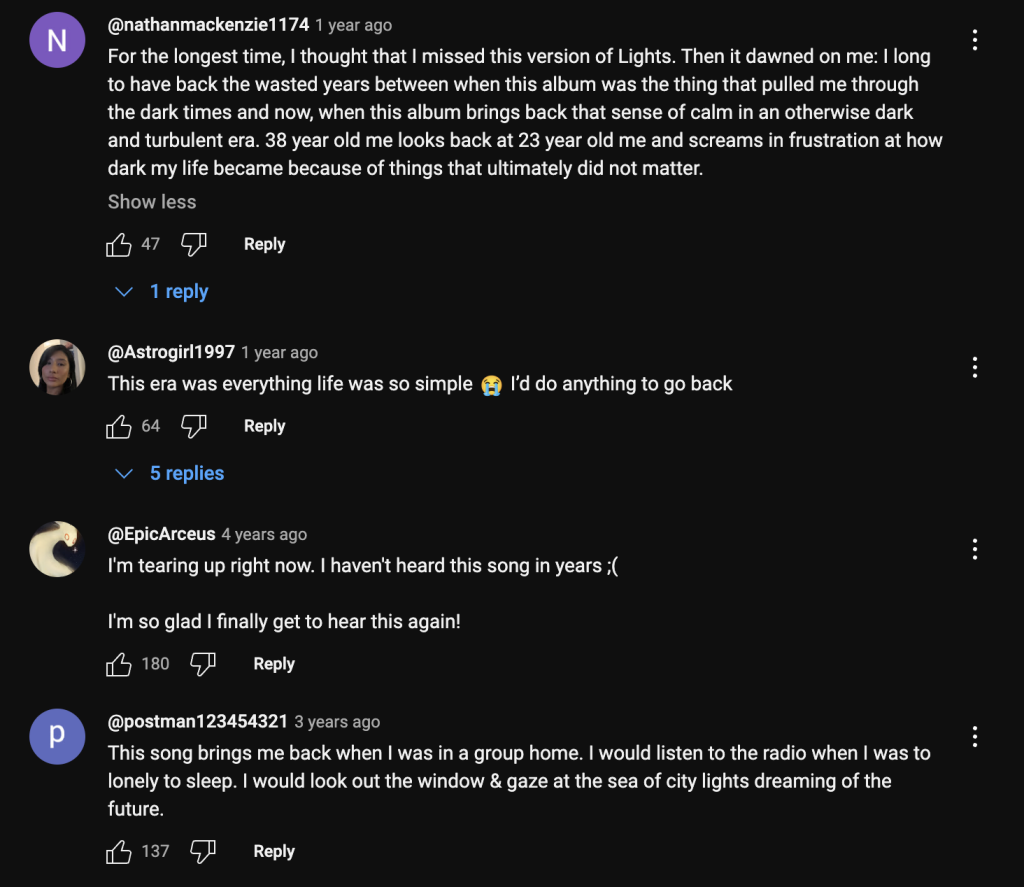
It’s really magical how people seem to be transported back to the good old days when they listen to this album. I go back to this album when I want to reconnect with the younger version of myself, and the feelings of aspiration and dreaming that were there before the adult world kicked in. For that reason, this album still stirs such strong emotions within me, stronger than the emotions it carried when I first fell in love with it. The years have made it heavy for me. That’s why even though I consider Siberia my favorite Lights album, it’s The Listening that hits me the hardest in my feelings these days.
I think I, like many other Lights fans, had an emotional reaction to the callback to The Listening in the music video for “Okay Okay” from 2022’s PEP. The concept of the video is that she doesn’t have money from the label to shoot a video for this song, so she’s cobbling something together herself, by reaching out to the different “versions” of her she’s manifested in her music and asking for ideas.
So she’s having these text convos with the versions of her from each song on this album, with one suggesting doing TikTok dances to her songs, another saying to try a live concert clip, etc. — until one suggests going with an “old school” vibe…
When she popped out as The Listening-era Lights, I definitely shed a happy tear :’) It was like every time Kiryu puts on his grey suit again in the Yakuza series (IYKYK haha).
Likewise, it was beautiful seeing the collective appreciation for The Listening and the fanbase it formed culminating in a song commemorating the album’s 10th anniversary and its impact on Lights’ career. And the cover art riffing on the Acoustic EP was the icing on top. “Long live The Listening and everything in between“.
All of these things come together for me in telling the story of The Listening.
It’s an album that, in 2009, was looking back in time and reminiscing about the simplicity of childhood. Then, throughout the ensuing decade, we have all these fans coming back to this album to recapture the time in their lives when they were listening to this album, reminiscing about how those years around 2009 to 2011 were so much simpler. And for a song to then be released ten years later in 2019, looking back on The Listening itself, reminiscing about Lights’ own life at the time, and how time as passed since then — It’s all so perfect, isn’t it? We’re always looking back on the present time and saying it was golden — I wish we could see it as golden when we’re still here. I feel that’s what “Quiet” was always about to me.
What’s also interesting is how many of the lyrics on Lights’ later albums continue to explore the topics this album broaches upon. I didn’t reach this reading of The Listening until this year, but since I started writing this retrospective, a lot of lines on Little Machines and Pep seem to glow with further nuance. I will likely cover these more when I review those albums, but to explain what I mean, it seems those later albums still reflect on this idea of becoming an adult meaning a lack of objective guidance. But where The Listening felt apprehensive about these changes, I think songs like “Lucky Ones” and the entirety of Pep express a more firmer confidence about taking life as it comes and letting a lot of that anxiety melt away. I definitely had that same growth in myself over the last few years; we can’t really predict life or try to force it into a path we’ve pre-decided, we just have to figure out what kind of person we want to be and let that guide us through whatever absurd randomness life hits us with.
Who knows?
Doesn't matter anyway
Let's go
You and I will be okay
'Cause after all this time
Still don't know where we're going
But look how far we've come
And as long as you're just as lost as I am
I'll hold you in the morning
Like we're the lucky ones
Hey, we made it this far
I'm here undirected
No one knows where we are
We're just guessing
Conclusions + A Round Of Applause
So yes, revisiting this album brought back a lot of touching memories, reminding me why I loved it in the first place, and revitalizing my love for Lights’ music.
And yet, I feel as a teenager I didn’t fully appreciate how unique this album was. Bubbly, spacey synth pop isn’t as common as we’d like to think it is. And synth-pop that can pack as much emotion into each song is even harder to find.
I think I’ve finished with the main analysis I wanted to make of this album, what it means, and how it has changed over time. Now, in light of that, I feel like it’s worth ending this review with some much due praise of things I feel Lights deserves more credit for, that most music discourse doesn’t seem to have shined a light on.
In my opinion, this album stood the test of time due to a few things Lights did very uniquely, especially considering the time when The Listening was released.
It’s a markedly introspective album, one that was unafraid to speak candidly about emotional and existential problems. With how the last decade of pop music has been defined by introversion, a rejection of grandiose larger-than-life superstar personas, and further honesty and effort within the lyrics, it’s easy to miss that this album came well before that shift. Artists like Lorde, Broods, and CHVRCHES brought this more intelligent, reflective, introspective side to pop music, but those acts didn’t break onto the scene until 2013 at the earliest.
Lights was already doing that here, in 2009. She’s not the first to express herself sincerely on a pop song, but before 2010, there were very few being so transparent, especially compared to how that has become the modus operandi for many artists now. Pop was still squarely in its era of singers being these mythical, grandiose superstars. Lights at the time was already ahead of the curve I think, instead being this very relatable, forthcoming artist. Not only in her music, but also in the way she was so directly connected with her fans through social media.
Really, think about it. The most prevalent characteristics that defined pop music marketing from 2010 to 2020 was relatable vent-y lyrics, increased usage of social media for promotion, and breaking down that fourth wall between the star and the listener and replacing it with a perceived “I’m just like you!” persona. In truth, when combined with capitalism and consumerism, we see this dynamic now veering ever closer to what we now call a parasocial relationship between the artist and the listener.
Lights since 2009 has been the genuine, non-manufactured version of this — It feels like some label exec saw how she wrote her music, promoted it on MySpace, did vlogs, and cultivated the admiration of her fans, and decided that should be the template moving forward for blowing up an artist on the internet. She was even doing livestreams well before I remember anyone else doing it!
I think she also deserves a lot of credit for being this kind of artful, thoughtful pop artist well before it became the trend in the mainstream, and more importantly, before it became appreciated and accepted by critics. Media journalism shifted into its period of “poptimism” later in the 2010s, marking a greater critical appreciation for popular media in being able to create genuine, meaningful art while still crafted to have broad appeal. I think had The Listening and Siberia come out just four or five years later, these albums, and Lights herself, would have garnered much further acclaim and appreciation for their artistic merit. Even amidst an energetic catchy song, Lights never hesitates to still give the lyrics that extra bit of attention, to truly make the writing strong enough to stand on its own two feet, even if the music were not there to back it. This isn’t a hypothetical either, you can listen to any of her acoustic albums and see how her writing can shine through even when the entire backing instrumental is upheaved.
The adventurousness of her music doesn’t stop with switching from synths to acoustic either. As is with any other album in Lights’ discography, The Listening stands unique because she has never repeated herself. Siberia was noticeably different in themes and sound, as were her third, fourth, and fifth albums.
I think this album will always be special in her catalog for how the writing is so direct, unembellished, lacking pretense. In my review of Siberia I spoke on how my favorite part of Lights’ writing is the abstract, fantastical nature of it, where the meanings of lines are often obscured ever-so-slightly by the imagery they evoke; on The Listening, the emotions are laid bare in plain language. If there’s one thing that’s prominently showcased on The Listening, it’s feeling.
My favorite lyric on this entire album is also the most simple, the most direct. It’s on “Saviour”:
I just want to be so much.
This line gets to the heart of this album. It encapsulates what I find most salient in her writing style on this album. One line, seven words, but the emotion contained within is deep as an ocean. Yearning is the essence of this album, and it’s in this line where I see it put forth most directly, without qualification, without hesitation. This line isn’t written with some prosaic, ornate complexity — but the feeling is so convincing. It’s an unrelenting, deep yearning that can only be expressed as “I just wanna be so much”. Nothing more needs to be said. On the verge of new adulthood, it feels like ambition, like drive, in anticipation of all the possible things a person can grow to be.
On the other hand, the sound of this album is at once somber and exuberant, with songs like “February Air” and “Drive My Soul” feeling like a warm fire on a cold night. Her singing here is breathier, more expressive. There’s an analog warmth to the whole album sonically and vocally that stands in stark contrast with the frigid and synthetic palette of Siberia or the organic live rock aesthetic of Pep.
It is in these differences that I feel we can best find Lights’ talent. It’s very hard to make one great album, to construct one unique sound and stick to it for a full project. It’s much, much harder to do that with each album, continuously evolving, changing , and reacting to the aesthetics and themes of the previous project.
I think The Listening is a gem of an album, one that I’ve cherished for a long time. I’ve been a fan of so many genres, from metal to goth to hip hop to jazz, and yet this album remains atop my pantheon, firmly among the best of them all. I think this album is really special for how it is able to so cogently capture that feeling of waywardness we feel when first moving into adulthood, with every path ahead of us and no clear guidance on which one to take. This album speaks movingly to the stresses that come from trying to create our own meanings in that phase of our life, whether through our connections to faith or nature, in embracing our emotions with openness, or in seeking to uplift others. And as time has marched onwards, this album still holds a special place in a lot of people’s hearts. For the love this album brings out from its fans, I think Lights is definitely owed her flowers.
To Lights — As time passes, we will always be listening.
Hey I just wanted to throw this comment in and tell you that I appreciate your post about this album that too changed my life in a positive way. Thank you for your memento to this amazing album.
Thank you!! I’m glad you enjoyed reading this. I really wanted to capture my love for this album and share it with the Lights fan community — and her! I got to share this site with Lights when I met her on tour recently.
Thanks for your kind words 🙂